|
What it's all about: CDendro is intended to help you crossdate wood samples towards each other!
Some of the mathematics used for crossdating is outlined in the section "Dendrochronology, curve matching and mathematics".
There you will find a description of "Normalization" as a way to prepare growth data to make finding the "right match" more successful.
After the normalization has been done, comparison of two curves are based on calculating correlation coefficient values out of all possible overlapping positions for the two curves. Such calculations can be quickly done with modern computers. There are other methods for scoring how well two samples match at a certain overlapping position. One of them is the "Gleichläufigkeit". The Gleichläufigkeit score is based on counting how well the two trees have followed each other in growth over the years when comparing at a certain overlapping position.
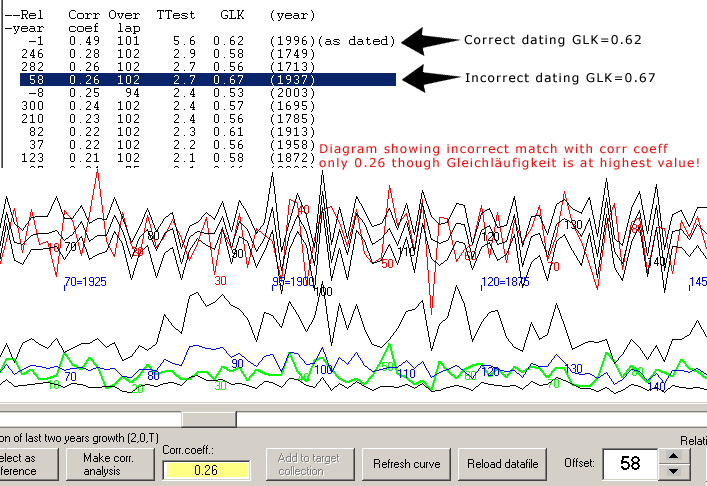
As a few CDendro users asked for this type of score, it has been made available in CDendro. Though you have to turn on a setting to make it displayed in tables. In the diagram below, please find an example. |
|
As you can see in the example above an incorrect dating may easily have a higher Gleichläufigkeit value than the correct dating. Typically this occurs when comparing a log from one area to a reference curve from - not the same but - a neighbour area. In discussions, I have met people who strongly defend the Gleichläufigkeit values and pretend they are a good complement to other values. Today I would partly agree - though only when "as a complement" is being stressed. Gleichläufigkeit values are available within CDendro so you can build your own opinion of its usefulness. You can turn on or off Gleichläufigkeit calculations in the panel "Options for normalization of ring widths and for matching". Here is a citation from a paper by Douglas Keenan (see the section on Other sites):
An exact description on calculating Gleichläufigkeit is found in the reference "BECKER AND GERMAN DENDROCHONOLOGY", see the section on Other sites. |
More comments on Gleichläufigkeit
|
The invention of the Gleichläufigkeit (GLK) value is sometimes described as a breakthrough in dendrochronological technology.
I have thus implemented mechanisms in CDendro to get some simple statistics on the quality of GLK based crossdating. First, we will see how a group of 80 years long segments (blocks) taken out of samples (members) of the ITRDB collection swed308.rwl (Saltsjöbaden) crossdate to the rest of that collection. We will then first use the CDendro P2Yrs method for crossdating (proportion of last two years growth) and then we will use the GLK method. After that we will do the same crossdating with the reference taken from an island some 20 miles East of Saltsjöbaden. For that we will use a mean value curve created from the ITRDB collection swed302.rwl. To see a summary of this short investigation, scroll down to the end of this section! |
Cropping the collection |


| The diagram shows the members of the cropped collection. Each 80 years long block (segment) will have a right position for matching towards the rest of the collection even when we exclude other radii from the same tree, i.e. running with Sum by stem checked. |


| The result above shows that when using the P2Yrs normalization method for crossdating, then the best match for each block is also the right match! If we only accept T-values above 6 we will be able to crossdate som 80% of our 80 years long blocks without any crossdating errors when we use the P2Yrs method! |

| Now select Gleichläufigkeit as the primary method to find the right match. Please notice also the block length settings already used above for running the example. |

|
The result after again running "Test towards rest of collection"
shows that if we only accept GLK-values >= 0.70 then we will have no errors though we will only be able to crossdate some 65% of the blocks. (The
others will have their best GLK-value below 0.70!) - If we accept all GLK-values >= 0.64, then we will be able to crossdate 93% of our blocks, though 10% of our crossdatings will be wrong!
That was using GLK to crossdate a tree towards a reference consisting of trees which had grown in the very same neighbourhood of the first tree. We will now continue by looking at how GLK works when we try to crossdate trees from one area towards the reference of a more distant but anyhow neighbour area. |

| For this we will use a mean value .wid curve from the island of Nämdö. It is created from the ITRDB swed302.rwl collection using the "Create Mean value sample" button with Heavy detrending selected and with a frame length of 25. We open this sample and select it as the reference. Then we run "Test towards reference". |

This is what happens when we use GLK values to crossdate samples towards a reference which is not from the very same area as the samples to be crossdated! The problem gets worse with a lower correlation coefficient value between references from the two areas. The correlation coefficient between the Saltsjöbaden and the Nämdö collection is at 0.63 measured with the standard methods of CDendro. When correlation coefficient like P2Yrs is at 0.7 for two references from nearby areas, the problem with the GLK values is not as worse as shown above. Longer blocks also lessens the problem. To complete the comparisons, we will look at the result of the standard P2YrsL method in CDendro. Note: If you try to reproduce the results above with your own software, you may get somewhat different percentage values. This easily occurs because the sorting order for best match is undefined when there are more than one best match with exactly the same GLK value. This often occurs because of the construction of the Gleichläufigkeit algorithm. |

| Crossdating with the P2YrsL normalization method towards a reference from not the same but a nearby region.
The table says that if we only accept T-values >= 6 then we will be able to crossdate some 40% of our 80 years long blocks probably without any crossdating errors! |
This small investigation shows that
My conclusion: The Gleichläufigkeit method on its own should not be used for crossdating, though it might be a useful complement to other methods! |


| Some dendrochronologists want to see the Gleichläufigkeit (or "Trend") for the current overlapping position plotted along the ring width curve. The horizontal "trend bar" is then plotted gray for a year when the two curves "agree", i.e. when they both either increase or decrease their growing. In the right diagram above, a ring width has been removed from the curve (at the vertical line) which makes the trend bar go almost white on the right side of the vertical line = no match here! - The overall GLK value for the left curve is 0.71, i.e. quite a high GLK value! Sample: SNKB07B. |
For a polemical text related to Gleichläufigkeit, see this by Douglas Keenan!
|
Allan Buras at the university of Greifswald has remarked that the common GLK value is erronously calculated when two successive ring widths in both curves have their ring width values repeated, i.e. when the width increment (or decrement) from one year to the next happens to be exactly zero in both series. In this case the tree growth is actually similar though that similarity does not give any "credit" to the mean GLK value. This problem is taken care of from CDendro version 7.8.1. For practical usage this update has little relevance. A concoct example demonstrating the problem is a series measured in millimeters but written to a file with only one decimal. This easily results in many successive ring widths becoming the same. Crossdating that series towards itself will give correlation coefficients of 1.0 as expected but the corresponding Gleichläufigkeit value will be only 0.92 The updated GLK algorithm in CDendro 7.8.1 will produce GLK=1.00 as to be expected. Reference:
|